
The School Quality Reports (SQR): Snapshot, produced by NYC Public Schools, displays information to help schools and communities understand equity, diversity, and inclusion (EDI) in their school. This information can be used to identify gaps and start a dialogue about changes to address disparities. See below for a summary of where to look for EDI data on the SQR: Snapshot.
Student Demographics
On the School Description tab, student demographics are provided in two different places. Under Student Body, you will find the overall student population breakdown by race/ethnicity, English language learners, students with IEPs, Economic Need Index, and gender. The SQR: Snapshot includes the percentages of students in the school who identify as female, male, and neither female nor male.

In the Surrounding Demographics section on the School Description tab, you will find the school's racial/ethnic demographics compared with that of other public-school students who live or go to school nearby.
- The dark blue bar shows the percentage of students from each racial/ethnic group at the school.
- The green bar shows the racial/ethnic breakdown of students in the school’s district (for elementary, middle, and K-8 schools) or borough (for high school, transfer schools, and D75 schools).
- The teal bar shows the racial/ethnic breakdown of public-school students who live near the school (the distance is displayed in the chart).
You can use this information to understand how your school’s demographics compare to the surrounding community.

Teacher Demographics
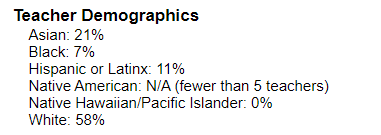
Teachers are an important part of the school community. In the Teacher Demographics section on the School Description tab, you will find the overall teacher population breakdown by race/ethnicity. You can use this information, along with student demographics, to understand the diversity of your school.
Advanced Courses
ONLY for high schools and transfer high schools
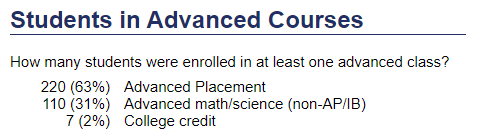
On the Instruction and Performance tab, the Students in Advanced Courses section lists the number of students who are taking different types of advanced courses at the school. Next to each number is the percentage of students in the school who are enrolled in the listed course types.
The Advanced Courses Demographics section lists the race/ethnicity of students participating in advanced courses.
- The dark blue bar shows the percentage of each racial/ethnic group at the school.
- The purple bar shows the percentage of each racial/ethnic group enrolled in any advanced course.
- The light blue bar shows the percentage of each racial/ethnic group enrolled in either Advanced Placement or International Baccalaureate courses.
You can use this information to understand what types of courses students are participating in and compare the percentage of students who are enrolled in advanced courses to the overall student population. If students are equitably enrolled in advanced courses, the three bars next to any given racial/ethnic group should be approximately equal in length. When looking at this data, it’s a good idea to be aware of the number of students included in the calculation. When a school has a small number of students enrolled in advanced or AP/IB courses, the movement of a single student in or out of a class can greatly impact the percentage for that student’s racial/ethnic group.

Students with Individualized Education Programs (IEPs)
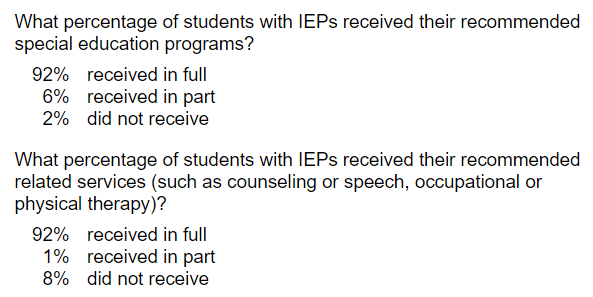
On the Instruction and Performance tab, look for the section titled Students with Individualized Education Programs (IEPs) (for District 75 schools, the section is titled Individualized Education Programs [IEPs]). The first part of this section shows how the school supports students with IEPs in learning alongside their general-education peers. Schools are rated on a scale of one to four, with one meaning “needs improvement”, two meaning “fair”, three meaning “good”, and four meaning “excellent.” Schools receive higher ratings when, over time, their students’ schedules include more time in class with general education students. More time with general education peers can result in higher scores on math and reading tests, fewer absences from school, and other benefits. When NYC Public Schools calculates this rating, it considers the scheduling of students with similar characteristics who attend different schools.

Also in this section, you’ll see the percentage of students with IEPs who received all, some, or none of the programs and related services that are recommended on their IEPs. Special education programs include, for example, placement in ICT classes, SETSS, and Special Classes (SC). Related services include, for example, occupational therapy, physical therapy, and speech. The "City" percentages show how many students are in each category across all NYC public schools.
Test Scores and Graduation Rates
The Instruction and Performance tab displays certain data broken down by student demographic groups. This allows you to identify whether disparities exist between student groups.
Performance on State Tests (elementary, middle, and K-8 schools only)
For elementary, middle, and K-8 schools, there are two sections that display New York State test results: one under the English heading, and one under math. Each section shows the performance of all students in the school. The bar chart below shows performance of students in different racial/ethnic groups, as well as English language learners, and students with IEPs. If students in each group scored equally well, all bars in the chart would be approximately the same length.

Graduation Rate (high schools and transfer high schools only)
For high schools and transfer high schools, the SQR: Snapshot displays graduation data. The Graduation section shows the school’s graduation rate, including all students in the graduating cohort. The bar chart below shows the graduation rate of students in different racial/ethnic groups and genders, as well as English language learners and students with IEPs. If students in each group had similar graduation rates, all bars in the chart would be approximately the same length.

NYC School Survey Results
The NYC School Survey is an annual survey that teachers and staff in grades 3-K through 12, and students in grades 6-12 are asked to participate in. The survey is designed to collect important information about each school's ability to support student success. Some of the questions from the NYC School Survey are displayed on the SQR: Snapshot, as described below. View responses to all of the survey questions.
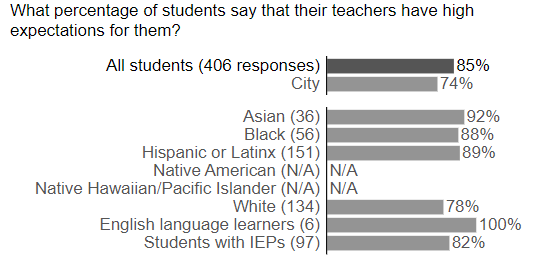
On the SQR: Snapshot, parent and student answers to NYC School Survey questions are broken out by racial/ethnic student groups, as well as English language learners and students with IEPs. There is a bar chart for each survey question displayed. The first row of the bar chart shows the percentage of students or parents in the school community who answered favorably. Below that, there is a row for each group. For parent questions, each parent’s answer is categorized based on the demographic characteristics of their child. In parentheses next to the name of each group, the SQR: Snapshot displays the number of respondents in the group. When fewer than five parents or students from a group have answered a question, the value in parentheses will be “N/A” and no bar will display. This is to protect respondents’ privacy. Keep in mind that when the number of respondents is very low, each respondent’s answer can have a great impact on the average for the group.
When reading the bar charts, look for cases in which the bars for various groups are different in length. This indicates that some groups answered very differently than others. These questions may help the school identify gaps and disparities in the experiences of different community members.
The teacher survey results are not reported by demographic groups, as teachers fill out the survey anonymously.
Seal of Biliteracy
Only for high schools and transfer schools
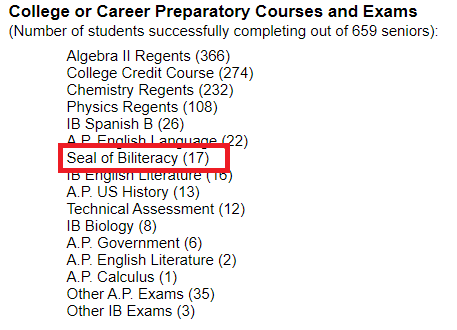
The New York State Seal of Biliteracy (NYSSB) is an optional program offered by some high schools and transfer schools. Students may earn this seal as a diploma endorsement. This seal recognizes high school graduates who have attained a high level of proficiency in listening, speaking, reading, and writing in one or more languages, in addition to English. If students at a school earned the Seal of Biliteracy, you will see that listed in the College or Career Preparatory Courses and Exams section of the Instruction and Performance tab.
For additional information about how NYC Public Schools shares data about school quality, please review School Quality Reports and Resources. Return to the School Quality Reports: Snapshot.